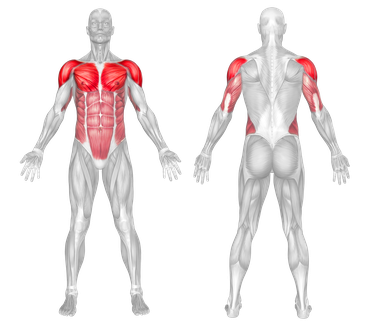
The Kettlebell Floor Press, also known as Kettlebell Floor Chest Press or Double Kettlebell Floor Press, is an intermediate-level strength exercise that primarily targets the chest (pectorals) and shoulders (deltoids), while also engaging the triceps and core muscles. This compound exercise requires kettlebells and is performed by pressing them while lying on the floor, making it a unique alternative to traditional bench presses due to the distinct weight distribution of kettlebells.
The exercise is beneficial for maintaining a neutral grip, which helps reduce joint stress and improve grip strength. The mechanics of this exercise classify it as a compound movement, meaning it involves multiple joints and muscle groups, providing a comprehensive upper body workout.
Kettlebell Floor Press Step-by-Step Instructions
- Sit on the floor with your legs straight and a pair of kettlebells beside you.
- Pick up the kettlebells and place them in your hip creak. Lie down while bringing the kettlebells up to your chest.
- Bend your knees and place your feet flat on the floor for stability.
- Press the kettlebells straight up by contracting your chest and triceps until your arms are fully extended.
- Lower the kettlebells slowly until your upper arms touch the floor, maintaining control throughout the movement.
- Repeat for the desired number of repetitions.
Kettlebell Floor Press, Tips for Proper Form
- Keep your wrists in a neutral position to reduce stress on your joints.
- Do not lock out your elbows completely to maintain tension on the muscles.
- Squeeze the kettlebell handles tightly to improve shoulder stability through irradiation.
- Avoid letting the kettlebells collide at the top of the movement to maintain control.
- If arching your back is an issue, try lifting your feet off the floor and keeping your knees together.
- Control the descent of the kettlebells and avoid bouncing your elbows off the ground to prevent wrist strain.
Kettlebell Floor Press Benefits
- Increases strength and size of the triceps and chest.
- Improves shoulder health and reduces joint stress due to the neutral grip.
- Enhances core stability and overall strength.
- Helps to improve the lockout phase of pressing movements like the bench press.
- Reduces the risk of shoulder injury by limiting the range of motion.
- Allows for unilateral training to correct muscle imbalances.
Kettlebell Floor Press Common Mistakes to Avoid
- Failing to maintain a neutral wrist position, which can increase wrist strain.
- Allowing the kettlebells to collide at the top, leading to loss of control.
- Bouncing the elbows off the ground, which can create compressive forces harmful to the wrists.
- Not keeping the shoulders firmly against the floor, which can compromise stability.
- Locking out the elbows, which reduces muscle tension and can lead to joint stress.
- Using too much weight, which can compromise form and increase the risk of injury.
Kettlebell Floor Press Summary
The Kettlebell Floor Press is a versatile and effective exercise for building upper body strength, particularly in the chest and triceps, while also improving shoulder health and core stability. Proper form and control are crucial to maximize benefits and minimize risks. This exercise is suitable for individuals looking to enhance their pressing strength and maintain joint health.
Kettlebell Floor Press FAQs
How often should I perform the Kettlebell Floor Press?
You can incorporate the Kettlebell Floor Press into your workout routine 2-3 times per week, depending on your overall training program and recovery ability.
What weight should I start with for the Kettlebell Floor Press?
Beginners should start with lighter kettlebells (8-16 kg) and gradually increase the weight as they become more comfortable with the movement and can maintain proper form.
Can I perform the Kettlebell Floor Press if I have shoulder pain?
The Kettlebell Floor Press can be more shoulder-friendly than other pressing exercises due to the neutral grip and limited range of motion. However, consult with a healthcare professional before starting if you have existing shoulder issues.
Is the Kettlebell Floor Press suitable for beginners?
Yes, the Kettlebell Floor Press is suitable for beginners, especially those looking to build upper body strength and improve joint stability.
Can I perform the Kettlebell Floor Press with one arm?
Yes, performing the Kettlebell Floor Press with one arm is a great variation that can help improve unilateral strength and core stability.
What are the primary muscles worked in the Kettlebell Floor Press?
The primary muscles worked are the chest (pectorals) and triceps, with secondary engagement of the shoulders (deltoids) and core muscles.