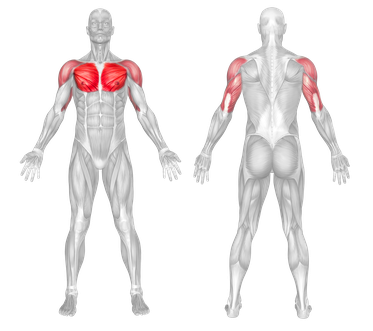
The kettlebell deep push-up, also known as the deficit push-up, is an advanced variation of the traditional push-up that primarily targets the chest (pectoralis major and minor), shoulders (deltoids), and triceps. This exercise is a compound movement, engaging multiple joints and muscle groups simultaneously. By incorporating kettlebells, the exercise increases the range of motion, allowing for a deeper stretch and more intense muscle activation.
The kettlebell deep push-up also significantly engages the core muscles (abdominals and lower back), enhancing overall stability and strength. Equipment required includes a pair of kettlebells, making this an exercise you can perform either at the gym or at home with the proper weights.
Kettlebell Deep Push-up Step-by-Step Instructions
- Place two kettlebells on the floor, slightly wider than shoulder-width apart, with the handles turned inward or facing each other.
- Assume a high plank position with your hands gripping the kettlebell handles and your legs extended behind you. Keep your feet together and your body straight from head to heels.
- Brace your core and glutes to maintain a stable position.
- Slowly bend your elbows, lowering your chest towards the floor while keeping your elbows close to your sides.
- Lower your chest until it is close to the ground, achieving a deep stretch.
- Push through your palms to extend your elbows and return to the starting position.
- Repeat for the desired number of repetitions.
Kettlebell Deep Push-up, Tips for Proper Form
- Ensure your spine remains neutral and straight throughout the movement to avoid lower back strain.
- Keep your elbows tucked in towards your body to reduce stress on the shoulders.
- Engage your core and glutes to maintain stability and prevent your hips from sagging.
- Avoid flaring your elbows outwards as this can cause shoulder impingement.
- Focus on a controlled descent and ascent to maximize muscle engagement and reduce the risk of injury.
- Keep your head in a neutral position, looking slightly ahead of you rather than up or down.
Kettlebell Deep Push-up Benefits
- Increases chest muscle activation due to the greater range of motion.
- Enhances shoulder and triceps strength and endurance.
- Improves core stability and overall balance.
- Promotes upper body strength and muscular development.
- Engages multiple muscle groups for a comprehensive upper body workout.
- Can be easily modified for progressive overload and adaptation.
Kettlebell Deep Push-up Common Mistakes to Avoid
- Allowing hips to sag or raise too high, which compromises core engagement.
- Flaring elbows out too wide, increasing the risk of shoulder injury.
- Using momentum to push up rather than controlled muscle contraction.
- Failing to maintain a straight line from head to heels, leading to poor form and potential back issues.
- Neglecting to brace the core and glutes, reducing the exercise's effectiveness.
- Breathing improperly; ensure to inhale on the way down and exhale on the way up.
Kettlebell Deep Push-up Summary
The kettlebell deep push-up is a challenging and effective exercise for enhancing upper body strength, core stability, and muscle endurance. By increasing the range of motion, this variation of the traditional push-up maximizes chest, shoulder, and triceps activation. Proper form and control are crucial to avoid common mistakes and reap the full benefits of the exercise.
Kettlebell Deep Push-up FAQs
How often should I perform kettlebell deep push-ups?
It is recommended to include kettlebell deep push-ups in your upper body workout routine 2-3 times per week, allowing adequate rest between sessions.
Can beginners perform kettlebell deep push-ups?
While this is an advanced exercise, beginners can start with regular push-ups and gradually progress to using kettlebells as they build strength and stability.
What are the benefits of using kettlebells for push-ups?
Kettlebells increase the range of motion, enhance muscle activation, and improve grip strength, making the exercise more challenging and effective.
Should I use heavy or light kettlebells?
Start with lighter kettlebells to master the form and gradually increase the weight as you become more comfortable and stronger.
What other exercises complement kettlebell deep push-ups?
Complementary exercises include kettlebell swings, rows, and shoulder presses to build overall upper body and core strength.
Can kettlebell deep push-ups help improve my traditional push-up performance?
Yes, the increased range of motion and strength gained from kettlebell deep push-ups can enhance your performance in traditional push-ups.