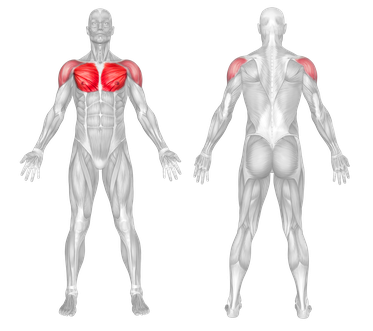
Dumbbell Flys, also known as Dumbbell Flyes, are an isolation exercise that targets the pectoralis major (chest) muscles. This exercise is ideal for building chest strength and muscle definition, making it a staple in many upper body workout routines. Suitable for beginners to advanced fitness enthusiasts, dumbbell flys also engage the anterior deltoids (front shoulders) and triceps (back of the upper arm) as secondary muscle groups.
The exercise involves a wide, controlled motion that emphasizes stretching and contracting the chest muscles. Dumbbell flys require a pair of dumbbells and a flat, incline, or decline bench, depending on the variation performed. The primary benefit of dumbbell flys is their ability to stretch and contract the chest muscles through a full range of motion, promoting muscle growth and flexibility.
Dumbbell Flys Step-by-Step Instructions
- Lie on a flat bench with a dumbbell in each hand, palms facing each other. Position your feet flat on the floor and your back flat against the bench.
- Extend your arms above your chest, keeping a slight bend in your elbows to prevent joint strain. This is your starting position.
- Inhale and slowly lower the dumbbells in a wide arc until they are level with your chest. Focus on feeling a stretch in your chest muscles.
- Exhale and bring the dumbbells back up to the starting position, using the same wide arc motion. Squeeze your chest muscles at the top of the movement.
- Repeat for the desired number of repetitions, maintaining control and proper form throughout the exercise.
Dumbbell Flys, Tips for Proper Form
- Maintain a slight bend in your elbows throughout the exercise to reduce stress on the elbow joints.
- Focus on a slow and controlled movement to maximize the stretch and contraction of the chest muscles.
- Avoid letting the dumbbells touch at the top of the movement, which can reduce tension on the chest muscles.
- Keep your back flat against the bench and avoid arching your back to maintain proper form and prevent injury.
- Engage your core muscles to stabilize your body and support your lower back during the exercise.
- Choose a weight that allows you to complete the exercise with proper form without compromising the range of motion.
Dumbbell Flys Benefits
- Increases chest muscle size and definition, contributing to a well-developed upper body.
- Enhances chest muscle flexibility due to the wide range of motion involved in the exercise.
- Strengthens the anterior deltoids and triceps, providing additional upper body conditioning.
- Improves muscle coordination and control by isolating the chest muscles.
- Supports overall upper body strength, beneficial for various pushing movements and exercises.
- Promotes balanced muscle development when combined with other chest exercises like bench presses.
Dumbbell Flys Common Mistakes to Avoid
- Using excessive weight, which can lead to poor form and increase the risk of shoulder injury.
- Allowing the elbows to bend too much, turning the exercise into a press rather than a fly.
- Dropping the dumbbells too low, which can strain the shoulder joints and reduce effectiveness.
- Arching the back, which compromises form and increases the risk of lower back injury.
- Failing to engage the chest muscles fully by rushing through the movement.
- Not maintaining control of the dumbbells, leading to an ineffective workout and potential injury.
Dumbbell Flys Summary
Dumbbell flys are a key exercise for enhancing chest muscle size, definition, and flexibility. By performing this isolation movement with proper form, you can maximize its benefits and reduce the risk of injury. Focus on controlled movements, avoid common mistakes, and incorporate dumbbell flys into your workout routine for balanced upper body development and improved muscle coordination.
Dumbbell Flys FAQs
How often should I perform dumbbell flys?
It is generally recommended to perform dumbbell flys 2-3 times per week, allowing at least 48 hours of rest between sessions to allow the muscles to recover and grow.
What is the ideal number of repetitions and sets for dumbbell flys?
The ideal number of repetitions and sets can vary based on your goals. For muscle growth, aim for 3-4 sets of 8-12 repetitions. For strength, perform 4-5 sets of 4-6 repetitions with heavier weights.
Can I perform dumbbell flys if I have shoulder pain?
If you experience shoulder pain, it is important to consult with a healthcare professional before continuing with dumbbell flys. They may recommend modifications or alternative exercises to avoid aggravating the condition.
Are there variations of dumbbell flys?
Yes, there are several variations, including incline dumbbell flys, decline dumbbell flys, and cable flys, each targeting the chest muscles from different angles and providing unique benefits.
Is it better to do dumbbell flys on a flat, incline, or decline bench?
Each bench angle targets different parts of the chest. Flat bench flys target the middle chest, incline flys focus on the upper chest, and decline flys emphasize the lower chest. Incorporating all three variations can lead to well-rounded chest development.
What should I do if I notice one side is stronger than the other?
If you notice a strength imbalance, focus on unilateral exercises, where each side works independently. This can help ensure both sides develop evenly and correct any imbalances over time.