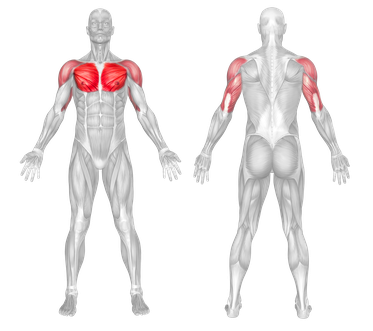
The Dumbbell Bench Press, also known as the Dumbbell Chest Press, is a foundational exercise in strength training, targeting the pectoralis major (chest) while engaging several secondary muscle groups. As a variation of the traditional barbell bench press, this exercise offers increased range of motion and stabilizer engagement. Suitable for various experience levels, the Dumbbell Bench Press is categorized as a compound movement, requiring coordination across multiple joints and muscle groups. It primarily targets the chest while also involving the triceps brachii (back of the upper arm), anterior deltoids (front of the shoulders), and stabilizers like the serratus anterior and the muscles of the rotator cuff. To perform this exercise, you'll need a pair of dumbbells and a flat bench.
Dumbbell Bench Press Step-by-Step Instructions
- Sit on the edge of a flat bench with a dumbbell in each hand, resting on your thighs. Your feet should be flat on the floor, slightly wider than shoulder-width apart.
- Lean back and simultaneously lift the dumbbells over your chest, with your palms facing forward. Ensure your back is flat against the bench and your shoulders are pinched together to stabilize your upper body.
- Position the dumbbells at shoulder width, with your elbows bent at approximately 90 degrees. This is your starting position.
- Press the dumbbells upwards by extending your elbows and squeezing your chest. Ensure that the dumbbells move in a straight line over your chest, not your face or abdomen.
- At the top of the movement, pause briefly, keeping your arms fully extended but not locked out. Your wrists should remain stable and in line with your forearms.
- Slowly lower the dumbbells back to the starting position, maintaining control throughout the descent. Ensure your elbows do not drop below the bench level to avoid excessive shoulder strain.
- Repeat for the desired number of repetitions, maintaining a steady and controlled tempo.
Dumbbell Bench Press Tips for Proper Form
- Maintain a tight grip on the dumbbells to prevent wrist strain and ensure control throughout the movement.
- Engage your core by tightening your abdominal muscles to maintain stability and protect your lower back.
- Use a full range of motion but avoid overextending your elbows at the top to keep the tension on the chest muscles.
- Keep your feet firmly planted on the floor to provide a solid base and improve balance during the lift.
- Focus on your breathing: exhale as you press the dumbbells up and inhale as you lower them back down.
- Ensure your shoulder blades remain retracted and pressed into the bench throughout the exercise to stabilize your shoulders and prevent injury.
Dumbbell Bench Press Benefits
- Increases chest muscle strength and size, enhancing upper body aesthetics and performance.
- Improves shoulder stability and joint health by engaging the rotator cuff muscles.
- Enhances tricep strength, contributing to overall arm development.
- Promotes balanced muscle development by allowing each side of the body to work independently.
- Incorporates stabilizing muscles, improving overall upper body coordination and balance.
- Provides variation from the traditional barbell bench press, reducing the risk of overuse injuries.
Dumbbell Bench Press Common Mistakes to Avoid
- Poor Posture: Sitting with shoulders rounded and slumped over the dumbbells.
Solution: Sit up tall, pull shoulders down and back, and engage lats by digging elbows into your sides.
- Incorrect Elbow Position: Flaring elbows out to the sides, creating a "T" shape.
Solution: Tuck elbows at a 45-60 degree angle, keeping wrists stacked above elbows. Aim for the inside of the dumbbell to touch the outer lower corner of the chest.
- Lack of Control During Lowering: Letting gravity lower the dumbbells without control.
Solution: Actively pull the weight down, engaging your back and "rowing" the dumbbells to the bottom.
- Rushing the Eccentric Phase: Performing the lowering phase too quickly.
Solution: Slow down the eccentric portion, creating stability in the shoulder joint.
- Ignoring Leg Drive: Not engaging the feet and legs during the press.
Solution: Push down into your toes and straighten your legs out in front to create leg drive.
- Shoulder Dominance: Letting shoulders dominate the press instead of the chest.
Solution: Initiate the press with the chest, driving shoulders back into the bench and reaching up with the sternum.
- Improper Dumbbell Manipulation: Not manipulating the dumbbells in space during the press.
Solution: Tilt thumbs up to bring the dumbbells closer to the midline of the chest, simulating horizontal adduction of the arms.
Dumbbell Bench Press Summary
The Dumbbell Bench Press is a versatile and effective exercise for building chest strength and size while engaging various secondary muscles. By following proper form and avoiding common mistakes, you can maximize the benefits of this compound movement. Remember to incorporate this exercise into your routine for balanced upper body development and improved functional strength.
Dumbbell Bench Press FAQs
How often should I perform the Dumbbell Bench Press?
It is recommended to perform the Dumbbell Bench Press 1-3 times per week, depending on your overall training program and recovery capacity.
Can beginners perform the Dumbbell Bench Press?
Yes, beginners can perform the Dumbbell Bench Press with lighter weights and proper guidance to ensure correct form and technique.
What is the best way to incorporate the Dumbbell Bench Press into a workout routine?
Incorporate the Dumbbell Bench Press into your routine as a primary chest exercise, typically after a warm-up and before other chest or upper body exercises.
Is the Dumbbell Bench Press better than the Barbell Bench Press?
Both exercises have their advantages. The Dumbbell Bench Press offers a greater range of motion and engages more stabilizer muscles, while the Barbell Bench Press allows for heavier lifting and simpler progression.
Can I perform the Dumbbell Bench Press on an incline or decline bench?
Yes, performing the Dumbbell Bench Press on an incline or decline bench targets different areas of the chest and provides variation to your workout.
What should I do if I experience shoulder pain during the Dumbbell Bench Press?
If you experience shoulder pain, check your form, reduce the weight, or consult with a fitness professional to ensure you're performing the exercise correctly.