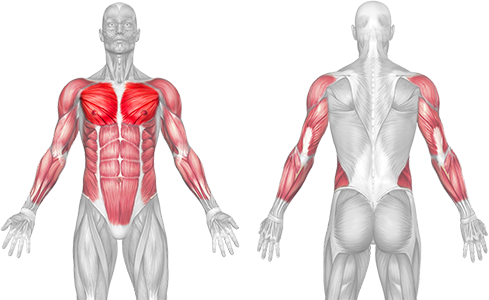
Decline Push-Ups are an advanced variation of the traditional push-up, designed to increase the difficulty and focus on the upper chest (pectorals) and shoulders (deltoids). Also known as decline bench push-ups, this exercise is recognized for its effectiveness in strengthening the upper body by altering the angle of the traditional push-up, thus increasing the resistance your muscles work against. Suitable primarily for those at an intermediate to advanced fitness level, Decline Push-Ups are categorized as a strength exercise. They are a compound movement, engaging multiple muscle groups including the secondary muscles like the abdominals, triceps, and lower back. This exercise requires minimal equipment, typically just a bench or any stable elevated surface.
Decline Push-Ups Step-by-Step Instructions
- Start by placing your hands on the ground slightly wider than shoulder-width apart. Ensure your hands are directly under your shoulders for proper support.
- Elevate your feet by placing them on the bench or elevated surface behind you. Your body should form a straight line from your shoulders to your heels, without sagging or arching at the hips.
- Engage your core and keep your elbows slightly bent to maintain tension in your upper body.
- Lower your body by bending your elbows until your chest nearly touches the floor. Keep your body straight and rigid throughout the movement.
- Press up through your palms, extending your elbows to return to the starting position.
- Repeat for the desired number of repetitions, maintaining form and controlled movements throughout the set.
Decline Push-Ups, Tips for Proper Form
- Keep your neck in a neutral position by looking down at the floor, not forward, to avoid neck strain.
- Avoid sagging your hips; keep your body in a straight line from head to heels.
- Do not flare your elbows out wide; keep them at about a 45-degree angle to your body.
- Engage your core throughout the exercise to stabilize your body and enhance strength transfer.
- Ensure your hands are set up correctly under your shoulders to avoid unnecessary shoulder strain.
- Control your descent; don't drop down quickly, as maintaining control helps enhance muscle engagement.
Decline Push-Ups Benefits
- Enhances upper body strength, focusing on the chest, shoulders, and triceps.
- Improves core stability and strength due to the elevated feet position.
- Increases the metabolic rate by involving multiple muscle groups, which can aid in fat loss.
- Develops muscle symmetry and balance by evenly distributing the muscle strain.
- Can be modified for different fitness levels by adjusting the height of the elevation.
- Helps improve posture and muscle endurance over time.
Decline Push-Ups Common Mistakes to Avoid
- Sagging the hips, which puts unnecessary stress on the lower back.
- Locking out the elbows at the top of the movement, which can strain the joints.
- Looking forwards instead of down, leading to neck strain.
- Not keeping the body in a straight line, which diminishes the effectiveness of the exercise.
- Allowing the elbows to flare out too much, which can stress the shoulders.
- Rushing the movements, which reduces muscle engagement and effectiveness.
Decline Push-Ups Summary
Decline Push-Ups are a valuable addition to an upper body workout routine, particularly for those looking to enhance upper body strength and core stability. Proper technique is crucial to maximize benefits and minimize risk of injury. Regular practice can lead to significant improvements in muscle strength and endurance, contributing to better overall fitness and functional daily movements.
Decline Push-Ups FAQs
How often should I perform Decline Push-Ups?
Two to three times a week is sufficient to see improvements without overstraining the muscles.
Can beginners perform Decline Push-Ups?
Beginners should start with basic push-ups and gradually progress to decline variations as they build strength and confidence.
What are the benefits of Decline Push-Ups compared to regular push-ups?
Decline Push-Ups target the upper chest and shoulders more intensely than regular push-ups, offering enhanced muscle engagement and strength development in these areas.
What variations can I try if Decline Push-Ups become too easy?
Variations such as the Single-Leg Decline Push-Up or using a stability ball can increase the difficulty by enhancing instability and requiring greater muscle control and strength.
Is there a risk of injury with Decline Push-Ups?
Yes, improper form, such as sagging hips or flared elbows, can lead to back and shoulder injuries. It's important to maintain strict form and progress gradually.
Can Decline Push-Ups help with weight loss?
While primarily a muscle-strengthening exercise, Decline Push-Ups can help with weight loss by increasing muscle mass, which boosts metabolism and burns more calories at rest.
How do I know if I'm performing Decline Push-Ups correctly?
Correct performance involves maintaining a straight line from head to heels, keeping the core engaged, and ensuring that your elbows do not flare out excessively.
Can Decline Push-Ups replace other upper body exercises?
While effective, Decline Push-Ups should be part of a balanced workout regimen that includes a variety of exercises to ensure all muscle groups are adequately worked.