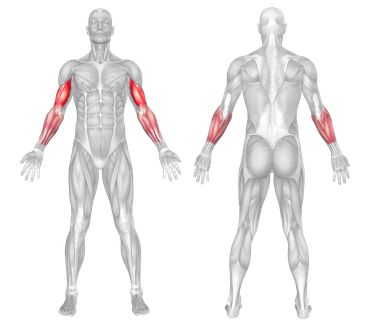
Concentration curls, also known as seated concentration curls, are a popular isolation exercise primarily targeting the biceps brachii (biceps). This exercise emphasizes the peak of the biceps by maximizing muscle contraction and is highly effective for building size and strength in the biceps.
Concentration curls can be performed using various grips and positions, each offering unique benefits. This exercise is suitable for beginners but can also be beneficial for more advanced lifters looking to fine-tune their arm training. It requires a dumbbell and a bench or chair, making it a versatile addition to any workout routine.
Step-by-Step Instructions
- Select a dumbbell of appropriate weight and sit on a flat bench with your legs spread, feet flat on the floor.
- Pick up the dumbbell with an underhand (supinated) grip and rest the back of your upper arm on the top of your inner thigh.
- Position your free hand on your other knee for stability.
- With your arm fully extended and the dumbbell not touching the floor, take a deep breath.
- Curl the dumbbell upwards in a smooth, controlled motion, focusing on contracting your biceps.
- Hold the peak contraction at the top for a second, then slowly lower the dumbbell back to the starting position.
- Repeat for the desired number of repetitions, then switch arms.
Tips for Proper Form
- Keep a slight bend in your elbow at the bottom to maintain tension on the biceps.
- Use a slow and controlled motion, especially during the eccentric (lowering) phase.
- Avoid using momentum; keep your upper arm stationary and perpendicular to the floor.
- Focus on the mind-muscle connection, ensuring you feel the biceps working throughout the exercise.
- Maintain a natural arch in your lower back to avoid strain.
- Adjust the bench height so your thighs are parallel to the floor for optimal positioning.
Benefits
- Enhanced Muscle Activation: Isolates the biceps, providing intense muscle engagement.
- Peak Contraction: Emphasizes the peak of the biceps, enhancing muscle definition.
- Improved Symmetry: Unilateral training helps correct strength and size imbalances between arms.
- Increased Mind-Muscle Connection: Focuses on the biceps, improving muscle control and growth.
- Versatility: Can be performed almost anywhere with minimal equipment.
- Convenient: Ideal for home workouts or when equipment access is limited.
Common Mistakes to Avoid
- Rushing the Reps: Perform reps slowly to maximize tension.
- Lack of Focus: Concentrate on contracting the biceps at the top of the movement.
- Incorrect Bench Height: Ensure the bench height allows for a full range of motion.
- Excessive Rest: Keep rest periods short to maintain muscle engagement.
- Neglecting Other Exercises: Include various bicep exercises to avoid imbalances.
- Using Too Much Weight: Lift a manageable weight to maintain proper form and avoid injury.
Summary
Concentration curls are an excellent isolation exercise for developing the biceps' peak and enhancing arm symmetry. This exercise requires minimal equipment and offers significant benefits, including improved muscle activation and mind-muscle connection. To perform it correctly, maintain proper form and focus on slow, controlled movements. Avoid common mistakes like using too much weight or rushing through reps. By incorporating concentration curls into your workout routine, you can effectively target and develop your biceps.
FAQs
How often should I perform concentration curls?
For optimal results, include concentration curls in your arm workout 1-2 times per week.
Can I perform concentration curls with other equipment?
Yes, variations can be done with cables or resistance bands to maintain constant tension on the biceps.
What is the ideal rep range for concentration curls?
Aim for 8-12 reps per set for hypertrophy, or 12-15 reps for endurance.
How can I avoid wrist strain during concentration curls?
Ensure your grip is firm but not overly tight, and maintain a neutral wrist position throughout the exercise.
Are there variations to increase difficulty?
Yes, you can perform standing concentration curls or use a hammer grip to target different parts of the biceps and forearms.
What should I do if I feel shoulder strain?
Re-evaluate your form to ensure your upper arm remains stationary and the movement is focused on the biceps.