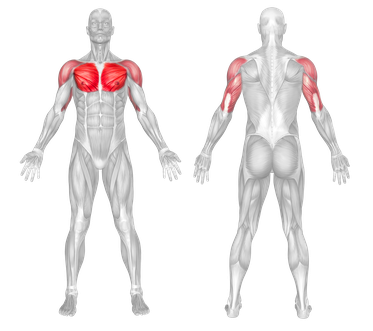
The Barbell Reverse Grip Bench Press is a strength-focused exercise that enhances upper body power by targeting primarily the chest (pectoralis major) and triceps, with secondary focus on the shoulders (anterior deltoids). Known as a variant of the traditional bench press, this exercise is characterized by its unique grip—palms facing towards the lifter, altering the engagement of the muscle groups. It's considered a compound movement due to its involvement of multiple joints and muscle groups. Suitable for intermediate to advanced lifters, this exercise requires a barbell and a flat bench to perform.
Barbell Reverse Grip Bench Press Step-by-Step Instructions
- Begin by adjusting the rack hooks to a height where your elbows are slightly bent when reaching for the bar. This setup reduces unnecessary strain and allows for a more focused exercise.
- Lie on the bench with your feet flat on the ground, aligning your eyes under the barbell for proper positioning.
- Grasp the barbell with a reverse grip (palms facing towards you), slightly wider than shoulder-width. Ensure your grip is secure and comfortable.
- Unrack the barbell with controlled motion and position it straight above your chest.
- Slowly lower the barbell towards your chest while keeping your elbows close to your body to maintain tension in the target muscle groups.
- Pause briefly as the bar touches your chest, then press it upwards, focusing on contracting the chest and tricep muscles to return to the starting position.
- Complete the desired number of repetitions and securely rack the barbell upon completion.
Barbell Reverse Grip Bench Press, Tips for Proper Form
- Ensure that your back remains flat on the bench throughout the movement to support spinal alignment and effective force application.
- Maintain a slight arch in your lower back to facilitate a better range of motion and activation of the chest muscles.
- Keep your feet planted firmly on the floor to stabilize your entire body and prevent unnecessary movement.
- Avoid locking your elbows at the top of the lift to keep constant tension on the muscles and reduce joint strain.
- Control the bar with a smooth, steady pace to maximize muscle engagement and reduce the risk of injury.
- Use a spotter when attempting heavier lifts to ensure safety and confidence during your sets.
Barbell Reverse Grip Bench Press Benefits
- Enhances upper body strength, particularly in the chest, triceps, and shoulders.
- Activates the upper chest more effectively than the traditional bench press, aiding in balanced muscle development.
- Introduces variety into your training regimen, which can help overcome plateaus.
- Provides a safer alternative for those with shoulder discomfort, due to the altered angle of the arms.
- Improves overall bench press technique by diversifying the muscles engaged during the exercise.
- Can be used strategically during deload phases to maintain intensity while reducing overall load.
Barbell Reverse Grip Bench Press Common Mistakes to Avoid
- Setting the hooks too high or too low, which can lead to inefficient lifts and increased injury risk.
- Over-gripping the bar which can lead to excessive wrist strain.
- Allowing the elbows to flare out, reducing the effectiveness on the target muscle groups and increasing shoulder strain.
- Lifting too quickly, which can compromise form and reduce the effectiveness of the exercise.
- Using too much weight too soon, which can lead to improper form and potential injuries.
- Not engaging the core throughout the lift, which is essential for stabilizing the upper body and supporting proper lift mechanics.
Barbell Reverse Grip Bench Press Summary
The Barbell Reverse Grip Bench Press is an effective exercise for targeting the upper chest and triceps, promoting strength and hypertrophy with a unique variation to the traditional bench press. It requires attention to form, particularly in grip and elbow positioning, to maximize benefits and minimize injury risks. With proper execution and integration into your workout regimen, it can significantly enhance upper body strength and muscle definition.
Barbell Reverse Grip Bench Press FAQs
How often should I perform the Barbell Reverse Grip Bench Press?
Incorporate this exercise into your routine 1-2 times per week to optimize muscle engagement without overtraining. It is best used as a supplementary exercise in an upper-body or chest-focused workout day.
What muscles does the Barbell Reverse Grip Bench Press target?
This exercise primarily targets the lower chest (pectoralis major) and the triceps (triceps brachii), with secondary emphasis on the shoulders (anterior deltoids).
Is the Barbell Reverse Grip Bench Press suitable for beginners?
While it can be suitable, it is generally recommended for those who have some experience with the traditional bench press due to its demand on wrist and shoulder positioning.
Can I use the Barbell Reverse Grip Bench Press if I have shoulder pain?
Yes, the reverse grip can reduce shoulder strain compared to the traditional bench press, but it should be approached with caution and proper technique.
What is the difference between a Reverse Grip and a Regular Bench Press?
The reverse grip shifts the focus more towards the upper chest and triceps, providing a different muscle stimulus than the regular grip, which targets the overall chest more evenly.
What are some common mistakes to avoid while performing the Barbell Reverse Grip Bench Press?
Avoid lifting too heavy too soon, flaring your elbows, and losing core engagement to ensure safety and effectiveness.