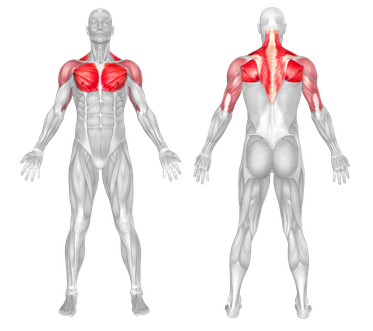
The Barbell Pullover with Bench Press is an effective exercise combining elements of the barbell pullover and the bench press to engage multiple muscle groups, making it excellent for building upper body strength and mass. This exercise is also known as the Barbell Pullover to Press. Suitable for intermediate to advanced fitness enthusiasts, it primarily targets the chest (pectoralis major) and upper back (latissimus dorsi), with secondary engagement of the shoulders (deltoids), triceps, and serratus anterior muscles. It is a compound exercise that requires a barbell and a flat bench.
Barbell Pullover with Bench Press Step-by-Step Instructions
- Lie flat on your back on a bench, ensuring your upper back and shoulders are comfortably positioned and your feet are flat on the ground for stability.
- Grasp the barbell with a shoulder-width overhand grip and extend your arms above your chest.
- With controlled motion, lower the barbell behind your head while keeping a slight bend in your elbows to maintain tension on your lats and avoid strain.
- Inhale as you lower the barbell and then exhale as you bring it back over your chest, preparing for the bench press phase.
- From the top position, shift your grip slightly and execute a bench press by lowering the barbell to your mid-chest and pressing it back up to the starting position.
Barbell Pullover with Bench Press, Tips for Proper Form
- Keep your movements controlled and smooth to focus the tension on the target muscle groups and minimize the risk of injury.
- Engage your core throughout the exercise to stabilize your body and support your lower back.
- Maintain a slight bend in your elbows during the pullover to avoid hyperextension.
- Ensure that your feet are firmly planted and your back remains flat against the bench during both the pullover and bench press phases.
- Adjust the weight of the barbell according to your strength level; avoid lifting too heavy too soon.
- Focus on breathing properly — inhale during the lowering movements and exhale during the lifting phases.
Barbell Pullover with Bench Press Benefits
- Enhances upper body strength, especially in the chest, back, and arms.
- Improves shoulder flexibility and mobility.
- Engages and strengthens the core, contributing to overall body stability.
- Promotes muscle growth and definition in the upper body.
- Can be modified for different fitness levels by adjusting the weight.
- Provides a comprehensive workout by combining two movements into one exercise.
Barbell Pullover with Bench Press Common Mistakes to Avoid
- Avoid letting your hips sag or your lower back arch excessively during the exercise.
- Do not rush the movements; using momentum reduces the effectiveness of the exercise and increases injury risk.
- Ensure not to lock your elbows fully at the top of the pullover to keep constant tension on the muscles.
- Do not lift the barbell too quickly or drop it too quickly; maintain control throughout.
- Be cautious not to flare your elbows wide during the bench press to keep the focus on your chest muscles and protect your shoulders.
- Do not neglect proper breathing technique as it is crucial for performance and safety.
Barbell Pullover with Bench Press Summary
The Barbell Pullover with Bench Press is a dynamic exercise that targets and strengthens multiple muscle groups in the upper body. It combines the stretching and contracting actions of the pullover with the pressing movement of the bench press, making it an efficient and effective component of any strength training routine. Proper form and technique are essential to maximize benefits and minimize the risk of injury. This exercise is particularly beneficial for those looking to enhance upper body strength, flexibility, and overall muscle development.
Barbell Pullover with Bench Press FAQs
How often should I perform the Barbell Pullover with Bench Press?
Frequency can vary based on your overall fitness goals and existing workout regimen, but generally, incorporating this exercise 1-2 times per week into your routine can be beneficial.
Can beginners perform this exercise?
While this exercise can be modified for beginners by reducing the weight and focusing on technique, it is generally recommended for those who have some experience with weight training due to its complexity and the coordination required between different muscle groups.
What are the key muscles targeted in the Barbell Pullover with Bench Press?
The primary muscles targeted are the pectoralis major (chest) and the latissimus dorsi (back). Secondary muscles include the triceps, deltoids, and rhomboids.
What equipment is needed for this exercise?
You will need a barbell and a flat bench to perform this exercise.
Are there any variations of the Barbell Pullover with Bench Press that I can try?
Yes, variations include using dumbbells instead of a barbell, or performing the pullover on an incline or decline bench to alter the muscle focus.
How can I ensure I'm performing this exercise safely?
Ensure proper form by keeping your movements controlled and avoiding excessive weights. Engage your core throughout the exercise, and keep your back flat against the bench. Proper breathing and gradual progression in weight are also crucial for safety.
Can this exercise help with functional strength for daily activities?
Yes, the Barbell Pullover with Bench Press helps build functional strength that can improve performance in a variety of daily activities by enhancing upper body strength and stability.