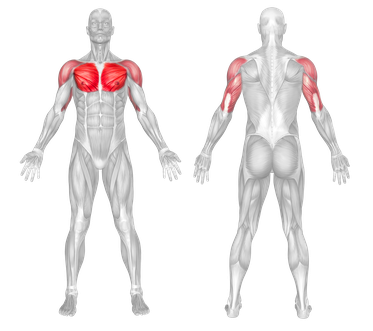
The Barbell Pause Decline Bench Press is an advanced variation of the decline bench press that targets the lower portion of the chest (pectoralis major), triceps (triceps brachii), and shoulders (deltoids). By incorporating a pause at the bottom of the lift, this exercise enhances muscle growth and strength by increasing time under tension and improving control. This exercise is classified as a compound movement, making it effective for overall upper body development. It requires a barbell and a decline bench, typically set at a 30-45 degree angle. This variation is particularly beneficial for intermediate to advanced lifters looking to build a fuller chest and increase their pressing power.
Barbell Pause Decline Bench Press Step-by-Step Instructions
- Set the decline bench to a 30-45 degree angle and secure your feet under the foot pads.
- Lie back on the bench with your feet firmly secured and your body stable.
- Grasp the barbell with an overhand grip, slightly wider than shoulder-width apart.
- Unrack the barbell and hold it directly above your lower chest with arms fully extended.
- Inhale and lower the barbell towards your lower chest, pausing for one to two seconds just above the chest.
- Exhale and press the barbell back up to the starting position, fully extending your arms.
- Repeat for the desired number of repetitions.
- Carefully rack the barbell when finished.
Barbell Pause Decline Bench Press Tips for Proper Form
- Maintain a firm and stable position by securing your feet and ensuring your back and shoulders stay in contact with the bench.
- Retract your shoulder blades to create a stable base for the lift.
- Focus on a controlled descent and avoid bouncing the bar off your chest.
- Keep your elbows tucked in to reduce shoulder strain.
- Use a spotter, especially when lifting heavier weights, to ensure safety.
- Keep your wrists straight and aligned with your forearms to prevent strain.
Barbell Pause Decline Bench Press Benefits
- Targets the lower portion of the chest for improved muscle definition and size.
- Increases overall chest strength and enhances pressing power.
- Reduces strain on the shoulders compared to flat and incline bench presses.
- Promotes greater muscle growth by increasing time under tension.
- Improves control and stability in the pressing movement.
- Helps to break through strength plateaus by focusing on the most challenging part of the lift.
Barbell Pause Decline Bench Press Common Mistakes to Avoid
- Failing to maintain proper back and shoulder contact with the bench, leading to instability.
- Bouncing the barbell off the chest instead of pausing, which reduces effectiveness and increases injury risk.
- Flaring the elbows excessively, causing shoulder strain.
- Lifting too much weight before mastering the technique, leading to improper form.
- Neglecting the use of a spotter, which is crucial for safety during heavy lifts.
- Allowing the bar to drift too far forward, which can compromise form and effectiveness.
Barbell Pause Decline Bench Press Summary
The Barbell Pause Decline Bench Press is an effective compound exercise for targeting the lower chest, triceps, and shoulders. Incorporating a pause at the bottom enhances muscle growth, strength, and control. Proper form and safety measures, such as using a spotter and maintaining stable positioning, are essential for maximizing the benefits of this exercise.
Barbell Pause Decline Bench Press FAQs
How often should I perform the Barbell Pause Decline Bench Press?
Incorporate it into your routine 1-2 times per week, allowing adequate recovery between sessions.
Can beginners perform the Barbell Pause Decline Bench Press?
It's recommended for intermediate to advanced lifters, but beginners can start with lighter weights and ensure proper form.
What are the benefits of pausing during the decline bench press?
Pausing increases time under tension, improves muscle control, and enhances strength and muscle development.
How long should the pause be?
Typically, a 1-2 second pause at the bottom of the lift is sufficient.
Is it necessary to have a spotter?
Yes, using a spotter ensures safety, especially when lifting heavy weights.
Can I incorporate other bench press variations with pauses?
Yes, variations like close-grip or reverse-grip decline bench presses with pauses can target different muscle groups and provide similar benefits.