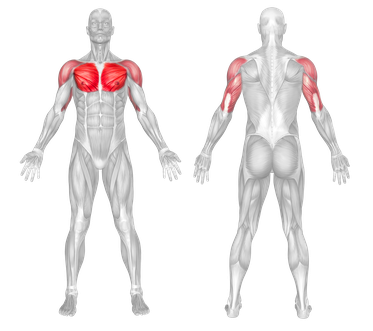
Barbell Bench Press, a cornerstone exercise in strength training, is renowned for its effectiveness in building upper body strength. Known alternatively as Bench Press, it targets primarily the chest muscles (pectorals), while also engaging the shoulders (deltoids), triceps, and to a lesser extent, the back. This exercise falls into the category of a compound movement due to its multi-joint functionality, requiring the coordinated effort of several muscle groups.
It is performed using a barbell and an exercise bench, making it accessible to a wide range of experience levels, from beginners to advanced lifters. The bench press is not just a strength exercise but also a staple in powerlifting and bodybuilding routines, emphasizing the importance of technique for maximum efficiency and safety.
Barbell Bench Press Step-by-Step Instructions
- Lie flat on your back on a bench with your feet firmly planted on the ground and your eyes directly under the barbell.
- Grip the bar with your hands slightly wider than shoulder-width apart, ensuring your wrists are straight and your thumbs are wrapped around the bar.
- Retract your shoulder blades and maintain a slight arch in your lower back while keeping your glutes and upper back in contact with the bench.
- Unrack the bar by straightening your arms and moving it to a position directly above your shoulders.
- Inhale deeply and lower the bar slowly to your mid-chest, keeping your elbows at a 45-degree angle to your body.
- Pause briefly when the bar touches your chest, then exhale and press the bar back up to the starting position by extending your arms.
- Repeat for the desired number of repetitions, ensuring each rep is controlled and performed with proper form.
Barbell Bench Press, Tips for Proper Form
- Maintain a tight grip on the bar to stabilize your wrists and prevent injury.
- Keep your feet planted and drive through your heels to create a stable base.
- Avoid flaring your elbows too wide; keep them at a 45-degree angle to reduce shoulder strain.
- Use a full range of motion, lowering the bar to your chest and extending your arms fully at the top.
- Engage your core and keep your lower back slightly arched to maintain stability.
- Focus on a controlled descent and explosive ascent to maximize muscle engagement and strength gains.
Barbell Bench Press Benefits
- Builds upper body strength, particularly in the chest, shoulders, and triceps.
- Enhances muscular hypertrophy (growth), contributing to a more defined and powerful physique.
- Improves functional strength, aiding in everyday activities that involve pushing and lifting.
- Balances muscle development, particularly for athletes who predominantly use pulling muscles.
- Increases bone density due to the weight-bearing nature of the exercise.
- Enhances overall athletic performance, making it beneficial for sports that require upper body strength.
Barbell Bench Press Common Mistakes to Avoid
- Arching the back excessively, which can lead to lower back strain.
- Allowing the feet to lift off the ground, reducing stability and power.
- Bouncing the bar off the chest, which can cause injury and reduces the effectiveness of the exercise.
- Using a grip that is too wide or too narrow, which can affect muscle engagement and increase injury risk.
- Not retracting the shoulder blades, which can compromise shoulder stability and increase the risk of injury.
- Holding the breath throughout the entire movement; instead, breathe in during the lowering phase and exhale during the pressing phase.
Barbell Bench Press Summary
The Barbell Bench Press is a fundamental exercise for developing upper body strength and muscle mass. By engaging the chest, shoulders, and triceps, it offers comprehensive benefits for functional strength and athletic performance. Proper form and technique are crucial to maximize the effectiveness of the exercise and prevent injuries. Regularly incorporating the bench press into your routine can significantly enhance your overall fitness and strength.
Barbell Bench Press FAQs
How often should I perform the Barbell Bench Press?
For optimal results, perform the bench press 2-3 times per week, allowing for sufficient rest and recovery between sessions.
Can beginners perform the Barbell Bench Press?
Yes, beginners can perform the bench press, but it's advisable to start with lighter weights and focus on mastering proper form.
What is the ideal grip width for the Barbell Bench Press?
A grip slightly wider than shoulder-width is ideal, as it allows for effective engagement of the chest muscles while minimizing strain on the shoulders.
Is it necessary to use a spotter when performing the Barbell Bench Press?
Using a spotter is recommended, especially when lifting heavy weights, to ensure safety and provide assistance if needed.
Can the Barbell Bench Press be modified for those with shoulder issues?
Yes, variations like the close-grip bench press or floor press can reduce shoulder strain while still providing the benefits of the bench press.
What are some common variations of the Barbell Bench Press?
Common variations include the incline bench press, decline bench press, and the close-grip bench press, each targeting different muscle areas and providing unique benefits.