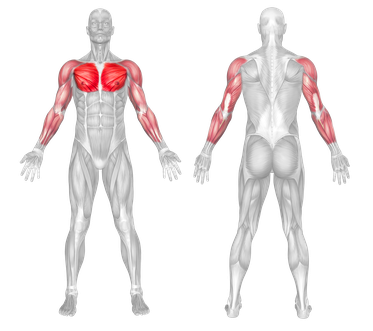
Push-ups are a classic exercise that targets the chest, triceps, and shoulders. They can be modified to suit different fitness levels, from beginner to advanced.
Step By Step Instructions:
- Start in a plank position with your hands slightly wider than shoulder-width apart and feet hip-width apart.
- Lower your body until your chest nearly touches the ground, keeping your core engaged and back straight.
- Push through your hands to straighten your arms, returning to the starting position.
Tips for Proper Form:
- Keep your body straight and aligned, avoiding sagging or arching your back.
- Engage your core and glutes to maintain a stable plank position.
- Lower slowly and smoothly, taking two to three seconds to descend.
Benefits of Push-Ups include:
- Build upper body strength: Push-ups are a great exercise for strengthening the chest, triceps, and shoulders.
- Improve posture: By engaging the muscles of the upper back, push-ups can help improve posture and prevent slumping or rounding of the shoulders.
- Increase core stability: The plank position used in push-ups requires engagement of the core muscles, including the abs and lower back, helping to improve overall stability and balance.
- Can be done anywhere: Push-ups don't require any equipment, making them a convenient and effective exercise that can be done at home or on the go.
- Low impact: Push-ups are a low-impact exercise, making them a good option for people who may be looking to avoid high-impact activities such as running or jumping.
- Modifiable: Push-ups can be modified to suit different fitness levels, from beginner to advanced, making them a suitable exercise for people of all abilities.
Common mistakes to avoid:
- Arching or sagging the back: Proper push-up form involves keeping the body straight and aligned. Arching or sagging the back can put unnecessary strain on the lower back and may cause discomfort or injury.
- Letting the hips sag or lift too high: It's important to maintain a stable plank position with the hips level throughout the exercise. Letting the hips sag or lift too high can disrupt the proper alignment of the body and reduce the effectiveness of the exercise.
- Drooping or lifting the head too high: Keep your head in line with your body and avoid looking up or down. This will help you maintain proper form and avoid straining the neck.
- Flaring the elbows: Keep your elbows close to your body as you lower and lift to better target the chest and triceps muscles. Flaring the elbows outward can put unnecessary strain on the shoulders.
- Not lowering to full range of motion: To get the most out of push-ups, be sure to lower your body until your chest nearly touches the ground. This full range of motion will help to fully engage and strengthen the targeted muscles.
- Going too fast: Proper push-up form involves a slow and controlled movement. Going too fast can compromise form and reduce the effectiveness of the exercise.
In summary, push-ups are a great exercise for building upper body strength and improving core stability. By following proper form and technique, you can effectively target your chest, triceps, and shoulders for a full-body workout.