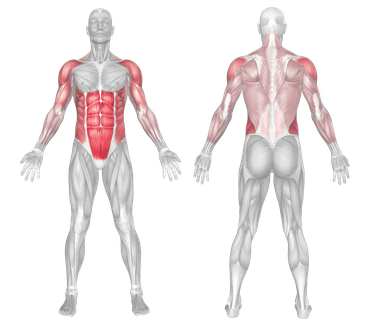
The High Plank, also known as a Front Plank or Push-Up Plank, is a fundamental body-weight exercise that targets the core muscles while engaging various other muscle groups. This exercise is ideal for individuals of all fitness levels, from beginners to advanced practitioners. As a strength exercise, the High Plank primarily targets the rectus abdominis (the "six-pack" muscles) and the transverse abdominis (deep core muscles), while also engaging secondary muscle groups such as the deltoids (shoulders), pectorals (chest), glutes (buttocks), and quadriceps (thighs).
The High Plank is a compound movement, meaning it involves multiple joints and muscle groups working together. No equipment is required for this exercise, making it highly accessible and versatile. Historically, planking exercises have been used in various fitness routines to build core stability and strength, which are crucial for overall physical health and performance.
Step-by-Step Instructions
- Begin in a kneeling position on the floor. Place your hands directly under your shoulders, slightly wider than shoulder-width apart.
- Extend your legs back one at a time to come into a push-up position. Your body should form a straight line from your head to your heels.
- Engage your core muscles by drawing your belly button towards your spine. Keep your hips level and avoid letting them sag or lift too high.
- Hold this position, ensuring your neck is in a neutral position by gazing at a spot on the floor about a foot in front of your hands.
- Maintain steady breathing throughout the exercise, focusing on keeping your form intact.
- To finish, gently lower your knees to the floor and sit back into a child's pose to relax your muscles.
Tips for Proper Form
- Keep your body in a straight line from head to heels to avoid straining your lower back.
- Engage your glutes and quads to support your lower body and prevent your hips from sagging.
- Keep your shoulders directly above your wrists to avoid unnecessary strain on your joints.
- Distribute your weight evenly between your hands and feet to maintain balance.
- Focus on steady, controlled breathing to maintain core engagement and overall stability.
- Start with shorter holds and gradually increase the duration as your core strength improves.
High Plank Benefits
- Improves core strength, enhancing overall stability and balance.
- Strengthens the shoulders, arms, and wrists, supporting upper body endurance.
- Engages multiple muscle groups simultaneously, providing a full-body workout.
- Enhances posture by reinforcing the muscles that support the spine.
- Boosts metabolic rate by engaging large muscle groups, aiding in calorie burn.
- Accessible exercise that requires no equipment, making it easy to perform anywhere.
Common Mistakes to Avoid
- Letting your hips sag, which can strain the lower back. Keep your body in a straight line.
- Lifting your hips too high, reducing the engagement of the core muscles.
- Placing your hands too far forward, increasing pressure on the shoulders.
- Neglecting to engage the core, resulting in poor stability and reduced effectiveness.
- Holding your breath, which can lead to fatigue and loss of form. Maintain steady breathing.
- Allowing your head to drop, which can strain the neck. Keep your gaze forward and neck neutral.
Summary
The High Plank is a versatile and effective body-weight exercise that targets the core while engaging multiple muscle groups. It's suitable for all fitness levels and requires no equipment, making it accessible and beneficial for improving strength, stability, and posture. Proper form and gradual progression are key to maximizing its benefits and preventing common mistakes.
FAQs
How often should I perform the High Plank?
For optimal results, aim to include the High Plank in your routine 3-4 times per week, allowing rest days in between for recovery.
Can beginners do the High Plank?
Yes, beginners can perform the High Plank by starting with shorter hold times and gradually increasing duration as they build strength.
What muscles does the High Plank target?
The High Plank primarily targets the core muscles, including the rectus abdominis and transverse abdominis, while also engaging the shoulders, chest, glutes, and quadriceps.
Is the High Plank a full-body exercise?
Yes, the High Plank engages multiple muscle groups throughout the body, making it an effective full-body exercise.
How can I increase the difficulty of the High Plank?
To increase the difficulty, try lifting one leg or one arm off the ground, or incorporating movements such as shoulder taps or knee-to-elbow taps.
What are common mistakes to avoid in the High Plank?
Common mistakes include letting the hips sag, lifting the hips too high, placing the hands too far forward, neglecting to engage the core, holding the breath, and dropping the head.