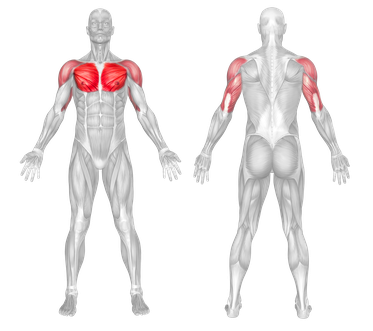
The Alternating Kettlebell Floor Press, a.k.a. Alternating Kettlebell Chest Press, is a dynamic strength training exercise designed to target the pectoral muscles (chest muscles) with additional focus on the triceps brachii (triceps) and deltoid muscles (shoulders). As a variation of the traditional kettlebell floor press, this exercise involves alternating arms, which enhances stability and engages the core muscles significantly.
This exercise is suitable for intermediate to advanced practitioners who are familiar with kettlebell movements. As a compound movement, it recruits multiple muscle groups and requires kettlebells for execution. The mechanics involve a pressing motion while lying on the floor, making it an excellent choice for those looking to build upper body strength without the need for a bench. The primary benefit of the Alternating Kettlebell Floor Press is its ability to improve unilateral strength and address muscle imbalances.
Alternating Kettlebell Floor Press Step-by-Step Instructions
- Lie on your back with a kettlebell in each hand, your knees bent, and feet flat on the floor.
- Hold the kettlebells at chest level with your palms facing forward, elbows bent at 90 degrees and resting on the floor.
- Engage your core and press one kettlebell upward until your arm is fully extended, keeping the other kettlebell stationary.
- Lower the pressed kettlebell back to the starting position, ensuring it’s controlled and smooth.
- Alternate to the other arm and repeat the pressing motion.
- Continue alternating arms for the desired number of repetitions, maintaining a steady pace and proper form throughout.
Alternating Kettlebell Floor Press, Tips for Proper Form
- Keep your core engaged throughout the exercise to maintain stability and prevent arching your back.
- Ensure your feet remain flat on the floor and your knees bent to provide a stable base.
- Control the movement on both the upward press and the downward phase to maximize muscle engagement and safety.
- Focus on a full range of motion but avoid locking out your elbows at the top to keep tension on the muscles.
- Keep your shoulder blades retracted and pressed into the floor to protect your shoulder joints.
- Maintain a neutral wrist position to avoid strain on your wrists and forearms.
Alternating Kettlebell Floor Press Benefits
- Enhances unilateral strength and helps correct muscle imbalances.
- Increases upper body strength, particularly in the chest, triceps, and shoulders.
- Engages the core muscles for added stability and strength.
- Reduces the risk of shoulder injuries by promoting proper shoulder mechanics.
- Provides a safer alternative to bench pressing, reducing stress on the lower back.
- Improves coordination and control through alternating movements.
Alternating Kettlebell Floor Press Common Mistakes to Avoid
- Arching the back excessively, which can lead to lower back strain. Keep the core engaged.
- Failing to control the kettlebell during the lowering phase, increasing the risk of injury.
- Locking out the elbows at the top of the press, which reduces muscle tension and can strain the joints.
- Allowing the non-pressing arm to drift away from the body, reducing stability.
- Using kettlebells that are too heavy, compromising form and increasing injury risk.
- Neglecting to retract the shoulder blades, which can cause shoulder impingement.
Alternating Kettlebell Floor Press Summary
The Alternating Kettlebell Floor Press is an effective compound exercise that targets the chest, triceps, and shoulders while engaging the core. It improves unilateral strength, addresses muscle imbalances, and promotes overall upper body development. Proper form and controlled movements are crucial to maximize benefits and prevent injuries.
Alternating Kettlebell Floor Press FAQs
How often should I perform the Alternating Kettlebell Floor Press?
Incorporate this exercise into your routine 2-3 times per week, allowing for rest days in between to promote muscle recovery.
What weight of kettlebells should I start with?
Begin with lighter kettlebells to master the form and gradually increase the weight as you become more comfortable and stronger.
Can I perform this exercise with dumbbells instead?
Yes, dumbbells can be used as an alternative to kettlebells if needed, though kettlebells offer a unique challenge in stability.
Is this exercise suitable for beginners?
This exercise is more suited for intermediate to advanced individuals. Beginners should focus on mastering basic kettlebell exercises first.
What should I do if I experience shoulder pain during the exercise?
Stop the exercise immediately and consult with a fitness professional to ensure your form is correct and to avoid further injury.
Can this exercise help with muscle imbalances?
Yes, the alternating nature of the exercise can help correct muscle imbalances by working each side of the body independently.