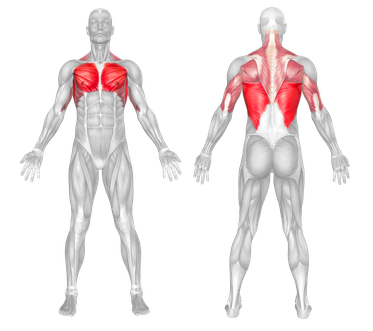
The Barbell Decline Pullover is a strength training exercise that primarily targets the latissimus dorsi (lats) and the sternal portion of the pectoralis major (lower chest). This isolation movement involves lying on a decline bench and performing a pullover motion with a barbell, effectively engaging both the back and chest muscles. It's particularly beneficial for individuals at a beginner to intermediate fitness level seeking to enhance upper body strength and muscle definition. The exercise requires a decline bench and a barbell, with an EZ-curl bar being a suitable alternative for those who find a straight barbell uncomfortable on the wrists.
In addition to the primary muscles worked, the Barbell Decline Pullover also engages secondary muscle groups, including the triceps brachii (long head), teres major, posterior deltoid (rear shoulder), rhomboids, levator scapulae, and pectoralis minor. This makes it an effective exercise for developing upper body strength and improving shoulder mobility. However, individuals with shoulder issues should approach this exercise with caution, as the movement can place stress on the shoulder joints.
The Barbell Decline Pullover is a versatile exercise that can be incorporated into various workout routines to target multiple muscle groups simultaneously. By adjusting the grip width or using different equipment, such as dumbbells or cables, individuals can modify the exercise to focus more on specific areas, such as the chest or back. It's important to maintain proper form throughout the movement to maximize effectiveness and reduce the risk of injury. This includes keeping the elbows slightly flexed, avoiding excessive arching of the back, and controlling the weight during both the lowering and lifting phases.
Step-by-Step Instructions
- Setup: Place a loaded barbell on the floor at the head end of a decline bench. Lie supine (on your back) on the decline bench and secure your feet under the foot pads. Reach back and grasp the barbell with a pronated (overhand) grip, hands slightly wider than shoulder-width apart.
- Starting Position: Press the barbell up over your chest, keeping your arms extended but with a slight bend in the elbows to reduce joint strain. Ensure your head, upper back, and lower back are firmly pressed against the bench.
- Descent: Inhale deeply as you slowly lower the barbell in a semicircular motion behind your head, maintaining the slight bend in your elbows. Lower the barbell until you feel a mild stretch in your chest and lats, or until your upper arms are in line with your torso.
- Ascent: Exhale as you reverse the motion, bringing the barbell back along the same path to the starting position over your chest. Maintain control throughout the movement to ensure continuous muscle engagement.
- Repeat: Perform the desired number of repetitions, typically ranging from 8 to 12 for muscle hypertrophy. Ensure consistent form throughout each rep to maximize effectiveness and reduce injury risk.
Tips for Proper Form
- Maintain Elbow Position: Keep your elbows slightly bent and fixed throughout the movement to protect your joints and focus the effort on the target muscles.
- Control the Movement: Avoid using momentum; perform the exercise slowly to maintain tension on the muscles and enhance effectiveness.
- Proper Breathing: Inhale during the descent and exhale during the ascent to maintain intra-abdominal pressure and support.
- Use Appropriate Weight: Select a weight that allows you to perform the exercise with correct form; starting with lighter weights is advisable to master the technique.
- Ensure Full Range of Motion: Lower the barbell until you feel a stretch in the chest and lats, but avoid overstretching to prevent injury.
- Keep a Stable Core: Engage your core muscles to maintain stability and prevent arching of the lower back during the exercise.
Barbell Decline Pullover Benefits
- Enhances Upper Body Strength: Targets both the chest and back muscles, contributing to overall upper body development.
- Improves Shoulder Mobility: The movement promotes flexibility and range of motion in the shoulder joints.
- Isolates Specific Muscle Groups: Focuses on the latissimus dorsi and pectoralis major, allowing for targeted muscle engagement.
- Complements Compound Movements: Serves as an excellent accessory exercise to enhance performance in compound lifts like bench presses and pull-ups.
- Promotes Muscle Hypertrophy: Consistent practice can lead to increased muscle size in the targeted areas.
- Supports Postural Improvement: Strengthening the chest and back muscles aids in maintaining proper posture.
Common Mistakes to Avoid
- Excessive Elbow Movement: Allowing elbows to bend or flare out can reduce effectiveness and increase injury risk.
- Overarching the Lower Back: Maintain a neutral spine to prevent unnecessary strain on the lower back.
- Using Excessive Weight: Lifting too heavy can compromise form; prioritize technique over heavy loads.
- Incomplete Range of Motion: Not lowering the barbell sufficiently limits muscle engagement; ensure a full stretch without discomfort.
- Holding Breath: Avoid breath-holding; maintain a steady breathing pattern to support performance.
- Rushing the Exercise: Performing reps too quickly can lead to poor form; execute movements deliberately.
Summary
The barbell decline pullover is an effective isolation exercise that targets the latissimus dorsi and lower pectoralis major muscles. By maintaining proper form and avoiding common mistakes, this exercise can enhance upper body strength, shoulder mobility, and postural alignment. Its inclusion in strength training routines is ideal for those seeking to build muscle or complement compound lifts.
FAQs
What muscles does the barbell decline pullover target?
The primary muscles targeted are the latissimus dorsi and the sternal portion of the pectoralis major, with secondary engagement of the triceps, posterior deltoids, and teres major.
Is the barbell decline pullover suitable for beginners?
It is generally recommended for individuals at an intermediate level or above due to the control and stability required. Beginners can start with lighter weights and progress gradually.
How often should I perform this exercise?
Incorporate it 1–2 times per week, depending on your overall training split and recovery capacity.
Can I perform this exercise without a decline bench?
Yes, but the decline bench provides a greater range of motion and enhances muscle activation. A flat bench is a suitable alternative if a decline bench is unavailable.
What is the optimal rep range for muscle growth?
A rep range of 8–12 is ideal for hypertrophy, ensuring proper form and controlled movement throughout each repetition.
How do I avoid shoulder strain during the exercise?
Keep your elbows slightly bent and maintain a controlled range of motion. Avoid overextending the arms or lowering the barbell too far behind the head.