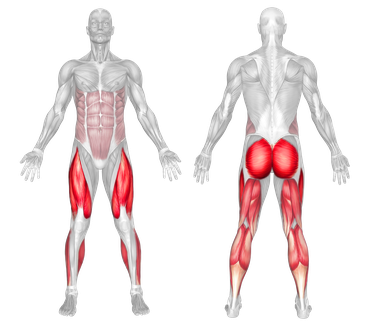
The Barbell Squats a foundational strength training exercise known for its effectiveness in building lower body strength and mass. Also known simply as "squats," this exercise primarily targets the quadriceps (front thighs) but also engages the gluteus maximus (buttocks), hamstrings (back thighs), and core muscles.
The Barbell Squat is categorized as a compound exercise due to its involvement of multiple joints and muscle groups. It is an essential move in many workout routines, from bodybuilding to general fitness, and is performed with a barbell, typically using a squat rack for safety and support. Suitable for individuals from Beginner to Advanced levels, the squat is renowned for its benefits, including enhanced leg strength, improved balance, and overall power.
Barbell Squats Step-by-Step Instructions
- Begin by positioning the barbell on a squat rack at about shoulder height. Load the desired weight onto the barbell.
- Stand under the barbell, positioning it across your upper back (trapezius muscles), and grip the bar firmly with your hands slightly wider than shoulder-width apart.
- Lift the barbell off the rack by straightening your legs and step back carefully to clear the rack. Position your feet shoulder-width apart with toes slightly pointed outwards.
- Take a deep breath, brace your core, and begin the descent by bending your knees and hips simultaneously, lowering your body as if sitting back into a chair.
- Keep your chest up, back straight, and knees aligned with your toes as you descend until your thighs are parallel to the ground or slightly below.
- Push through your heels to return to the starting position, extending your knees and hips until you are standing upright again.
- Exhale at the top of the movement and repeat for the desired number of repetitions.
Barbell Squats, Tips for Proper Form
- Maintain a neutral spine throughout the movement to avoid unnecessary strain on your lower back.
- Focus on keeping your knees in line with your toes to prevent knee injuries.
- Engage your core muscles to stabilize your torso and improve balance.
- Ensure that your feet are planted firmly on the ground, pushing through your heels during the ascent.
- Avoid allowing your knees to cave inward, which can lead to improper form and potential injuries.
- Use a spotter or squat rack with safety bars when lifting heavy weights to enhance safety.
Barbell Squats Benefits
- Increases overall lower body strength, targeting major muscle groups such as the quadriceps, hamstrings, and glutes.
- Enhances core strength and stability due to the engagement of abdominal and lower back muscles.
- Improves balance and coordination, essential for athletic performance and daily activities.
- Promotes functional fitness, aiding in everyday movements like sitting, standing, and lifting.
- Boosts anabolic hormone production, which can contribute to muscle growth and overall strength gains.
- Supports bone health by placing stress on the bones, promoting density and strength.
Barbell Squats Common Mistakes to Avoid
- Rounding the back, which can lead to spinal injuries. Always maintain a neutral spine.
- Allowing the knees to collapse inward, increasing the risk of knee injuries. Focus on keeping knees aligned with toes.
- Rising onto the toes instead of pushing through the heels, which can destabilize the movement and reduce effectiveness.
- Not squatting deep enough, limiting the activation of target muscles. Aim for thighs parallel to the ground or deeper if flexibility allows.
- Overloading the barbell without mastering proper form, increasing the risk of injury. Gradually increase weight as form improves.
- Neglecting the warm-up, which can lead to muscle strains. Always warm up properly before performing squats.
Barbell Squats Summary
The Barbell Squat is a fundamental exercise that targets multiple muscle groups in the lower body, including the quadriceps, hamstrings, and glutes. Known for its compound nature, it is an effective movement for building strength, enhancing balance, and promoting overall fitness. Proper form is crucial to maximize benefits and prevent injuries, making it essential to follow detailed instructions and tips. Whether you are a beginner or an advanced lifter, incorporating barbell squats into your routine can significantly contribute to your strength and conditioning goals.
Barbell Squats FAQs
How often should I perform Barbell Squats?
For most individuals, performing barbell squats 2-3 times per week is sufficient, allowing for adequate recovery between sessions.
Can I perform Barbell Squats if I have knee issues?
If you have knee issues, it is important to consult with a healthcare provider or physical therapist before performing barbell squats. They can provide guidance on modifications or alternative exercises.
What is the difference between a High-Bar and Low-Bar Squat?
In a High-Bar Squat, the barbell is placed on the upper traps, leading to a more upright torso position. In a Low-Bar Squat, the barbell is placed lower on the back, requiring a more forward lean. Each variation targets the muscles differently and suits different training goals.
How can I improve my squat depth?
Improving squat depth can be achieved through consistent practice, mobility exercises, and dynamic stretches targeting the hips, ankles, and lower back.
Is it necessary to use a squat rack?
While not absolutely necessary, using a squat rack significantly enhances safety, especially when lifting heavy weights. It provides support and helps prevent accidents.
What are some common squat variations?
Common squat variations include the Front Squat, Goblet Squat, Bulgarian Split Squat, and Box Squat. Each variation targets muscles differently and can be incorporated into a diverse workout routine.