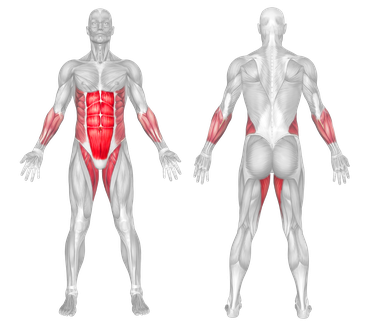
The Hanging Leg Raises a potent exercise aimed at enhancing core strength and stability. Often performed on a pull-up bar, this exercise primarily targets the rectus abdominis (lower abs) and hip flexors, with secondary engagement of the obliques. It's considered an advanced bodyweight exercise due to the strength and control required to perform it effectively. The mechanics of the Hanging Leg Raise categorize it as a compound movement, involving multiple joints and muscle groups simultaneously.
Hanging Leg Raises Step-by-Step Instructions
- Begin by hanging from a pull-up bar with a strong overhand grip and arms fully extended. Your body should hang straight with legs off the ground.
- Engage your core, flex your glutes, and slightly bend your knees if necessary. This will help stabilize your body and prevent swinging.
- Exhale as you raise your legs in front of you by bending at the hips, not the waist, aiming to get your legs to a 90-degree angle or higher.
- Hold the position briefly at the top, then inhale as you slowly lower your legs back to the starting position, maintaining control and keeping the movement smooth to avoid momentum taking over.
- Repeat the movement for the desired number of repetitions, ensuring to keep your core engaged and body stable throughout the set.
Hanging Leg Raises Tips for Proper Form
- Start with your body completely still to avoid using momentum.
- Focus on lifting your legs using your abdominal muscles rather than swinging them up.
- Keep your legs as straight as possible throughout the exercise to increase the intensity.
- Avoid arching your back; instead, keep your spine neutral.
- Control the descent of your legs to enhance the muscle activation and benefit of the exercise.
- For beginners, consider starting with bent knees and progressively straighten them as your strength improves.
Hanging Leg Raises Benefits
- Strengthens and tones the abdominal muscles and hip flexors.
- Enhances core stability and overall balance.
- Improves flexibility in the lower back and hips.
- Can be performed virtually anywhere with minimal equipment.
- Supports better posture and reduces the risk of back pain.
- Helps develop grip strength due to the need to hang from the bar.
Hanging Leg Raises Common Mistakes to Avoid
- Using momentum to swing the legs up instead of lifting them with control.
- Not engaging the core sufficiently, which can lead to swinging and reduced effectiveness.
- Allowing the body to curl or arch excessively during the movement.
- Failing to keep the legs straight, which can decrease the intensity of the exercise.
- Releasing tension in the abdominal muscles before completing the set.
- Rushing the movements, which can lead to poor form and potential injury.
Hanging Leg Raises Summary
The Hanging Leg Raise is an excellent exercise for enhancing core strength and stability. It requires minimal equipment and can be modified to suit different fitness levels. Maintaining proper form and technique is crucial to maximizing the benefits and minimizing the risk of injury. This exercise is not just about raising your legs; it's about controlling the movement and engaging your core to its fullest potential.
Hanging Leg Raises FAQs
What are the main muscles worked in the Hanging Leg Raises?
The primary muscles targeted are the rectus abdominis and hip flexors, with secondary engagement of the obliques.
How often should I perform the Hanging Leg Raises?
Integrate this exercise into your core or full-body workouts 2-3 times a week, depending on your overall fitness plan and goals.
Can I perform the Hanging Leg Raises if I have lower back issues?
Individuals with lower back issues should consult with a healthcare provider or a fitness professional before attempting this exercise. Modifications or alternative exercises might be recommended.
Are there any variations of the Hanging Leg Raises that I can try as I progress?
Yes, there are several variations that can help you increase the difficulty or focus on different muscle groups. Some popular ones include the Bent Leg Raise, Toes-to-Bar, Weighted Hanging Leg Raise, and the Hanging Windshield Wiper. Each variation has specific benefits and can be used to challenge your core strength and stability further.
What is the correct form to avoid injuries while performing Hanging Leg Raises?
Ensure you have a strong grip on the bar, start with your body completely still, and engage your core throughout the movement. Avoid swinging your legs and instead lift them using controlled motion. Keeping your legs straight and not allowing your lower back to arch excessively are also key points to maintain correct form and prevent injuries.
Can Hanging Leg Raises help improve my performance in other exercises?
Yes, Hanging Leg Raises can significantly enhance your core stability and strength, which are crucial for improving performance and efficiency in other exercises, including squats, deadlifts, and any movements requiring a strong foundation.